01
Kitáb-i-Aqdas
The Most Holy Book
Written in Arabic by Bahá'u'lláh in 'Akká around 1873. Laws, ordinances and moral guidance, with companion texts and notes.
Read the guide
Independent reference / Bahá'í literature
A neutral guide to the literature of the Bahá'í Faith: what the writings are, which texts matter most, how the calendar of nineteen months works, where the story reaches Haifa and how to read the originals online.
What this site covers
The Bahá'í Faith has no single holy book. It has a body of writings by the Báb, Bahá'u'lláh and 'Abdu'l-Bahá, with later guidance that explains how to apply them. This site maps that literature from the outside: the main texts and their order, the Kitáb-i-Aqdas, the Hidden Words, and the way the writings are published and read.
It also explains the frame around the texts: the nineteen-month calendar and its holy days, the history from 1844, the World Centre in Haifa, and music and the arts. It is an independent reference, not an official site, and it sells nothing.
The calendar
Each month has nineteen days and carries a name for a quality of God. Scroll to turn the wheel from Bahá, the first month, to 'Alá', the last.
Nineteen months of nineteen days make 361 days. The days of Ayyám-i-Há bring the year to its full length. How the calendar works
The shelf
Scroll and the books stack on top of each other. Each card names one work, who wrote it and where it sits in the literature.
01
The Most Holy Book
Written in Arabic by Bahá'u'lláh in 'Akká around 1873. Laws, ordinances and moral guidance, with companion texts and notes.
Read the guide02
153 short verses
Seventy-one verses in Arabic and eighty-two in Persian, composed by Bahá'u'lláh in Baghdad. Often the first text a reader meets.
Read the guide03
The Book of Certitude
A long work in Persian by Bahá'u'lláh, written in Baghdad in 1861, on the unity of the messengers of God and the meaning of scripture.
See where it fits04
A mystical treatise
A work by Bahá'u'lláh written in Baghdad on the stages of the soul's journey, paired in print with The Four Valleys.
See where it fits05
Selections by Shoghi Effendi
Extracts from the writings of Bahá'u'lláh, compiled and translated into English by Shoghi Effendi, arranged by theme.
See where it fits06
Talks of 'Abdu'l-Bahá
'Abdu'l-Bahá's answers to questions put to him in the early 1900s, covering religion, science, history and the soul.
See where it fitsA place for the story
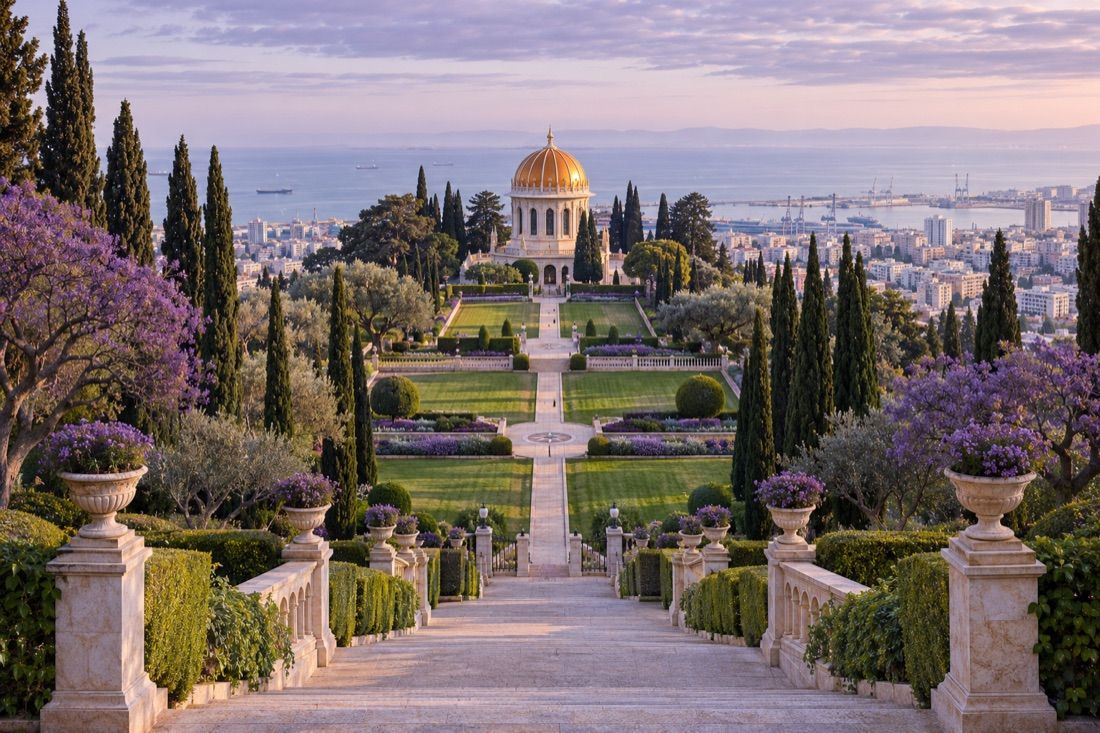
Bahá'u'lláh wrote most of his works in exile and died near 'Akká in 1892. The Báb's shrine stands on Mount Carmel in Haifa, framed by gardens laid out on nineteen terraces, and the Universal House of Justice has its seat there. UNESCO listed the Bahá'í holy places in Haifa and the Western Galilee in 2008.
The World Centre guide explains what each site is, and the history guide shows how the events behind them fit together.
Read the texts first. Then read about them.
All guides
01
There is no single Bahá'í Bible. This guide maps the writings of the Báb, Bahá'u'lláh and 'Abdu'l-Bahá and the texts that guide how they are read.
Read the guide02
The central book of Bahá'u'lláh: what the Arabic title means, when it was written, what it covers and which companion texts accompany it.
Read the guide03
A collection of short verses in two parts, one Arabic and one Persian, often the first Bahá'í text a new reader meets.
Read the guide04
How the Badíʿ calendar works: nineteen months, the days added between the eighteenth and nineteenth, the New Year at Naw-Rúz and the month names.
Read the guide05
Naw-Rúz, Ridván, the Twin Holy Days and the other days Bahá'ís keep, with what each commemorates and how the dates are set.
Read the guide06
The spiritual and administrative centre of the Bahá'í Faith: the Shrine of the Báb, the terraces on Mount Carmel, the Shrine at Bahjí and the Universal House of Justice.
Read the guide07
A plain timeline from the Báb's declaration in 1844 through Bahá'u'lláh's exile, 'Abdu'l-Bahá and Shoghi Effendi to the Universal House of Justice.
Read the guide08
Where the full texts are published, what an official library and an independent library offer, how to judge a translation and how to begin reading.
Read the guide09
How music and the arts appear in Bahá'í life: chanted verses, song books, inspired recordings, calligraphy and the nine sided Houses of Worship.
Read the guideQuick answers